Файл:Jupiter and the Galilean Satellites.jpg
Перейти до навігації
Перейти до пошуку

Розмір при попередньому перегляді: 420 × 599 пікселів. Інші роздільності: 168 × 240 пікселів | 336 × 480 пікселів | 538 × 768 пікселів | 1030 × 1470 пікселів.
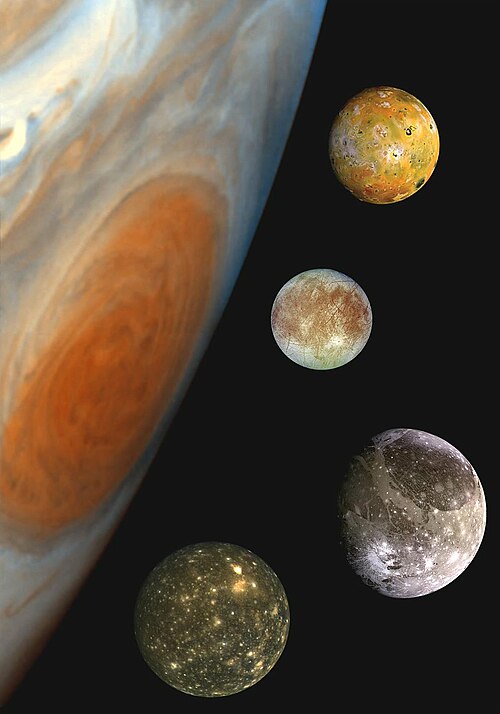


Повна роздільність (1030 × 1470 пікселів, розмір файлу: 127 КБ, MIME-тип: image/jpeg)

| Опис |
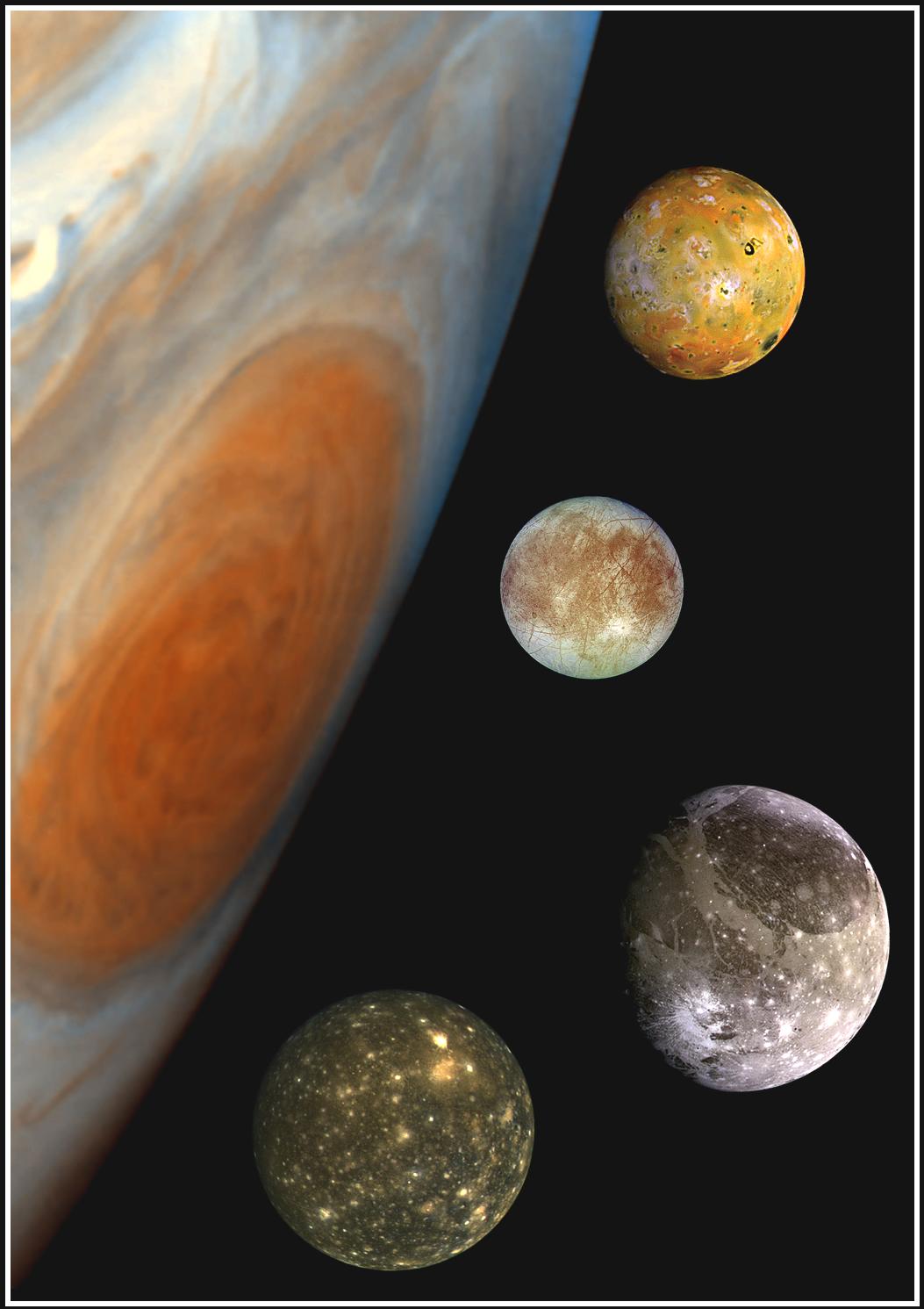
English: This "family portrait," a composite of the Jovian system, includes the edge of Jupiter with its Great Red Spot, and Jupiter's four largest moons, known as the Galilean satellites. From top to bottom, the moons shown are Io, Europa, Ganymede and Callisto. The Great Red Spot, a storm in Jupiter's atmosphere, is at least 300 years old. Winds blow counterclockwise around the Great Red Spot at about 400 kilometers per hour (250 miles per hour). The storm is larger than one Earth diameter from north to south, and more than two Earth diameters from east to west. In this oblique view, the Great Red Spot appears longer in the north-south direction. Europa, the smallest of the four moons, is about the size of Earth's moon, while Ganymede is the largest moon in the solar system. North is at the top of this composite picture in which the massive planet and its largest satellites have all been scaled to a common factor of 15 kilometers (9 miles) per picture element. The Solid State Imaging (CCD) system aboard NASA's Galileo spacecraft obtained the Jupiter, Io and Ganymede images in June 1996, while the Europa images were obtained in September 1996. Because Galileo focuses on high resolution imaging of regional areas on Callisto rather than global coverage, the portrait of Callisto is from the 1979 flyby of NASA's Voyager spacecraft.
Deutsch: 1610: Jupiter mit seinen vier größten Monden
Español: Los cuatro satélites galileanos, en una composición comparando sus tamaños con el tamaño de Júpiter. En orden descendente, son Io, Europa, Ganímedes y Calisto.
Français : Les quatre lunes galiléennes de Jupiter. De haut en bas : Io, Europe, Ganymède et Callisto.
日本語: 木星とガリレオ衛星の合成画像。上からイオ、エウロパ、ガニメデ、カリストの順。
Polski: Sztuczna kompilacja obrazów księżyców galileuszowych, pokazująca porównanie ich rozmiarów z rozmiarami Jowisza (widoczna Wielka Czerwona Plama). Od góry: Io, Europa, Ganimedes i Callisto. |
| Час створення | image published 18. Nov. 1997 |
| Джерело |
NASA planetary photojournal, borders removed by Daniel Arnold |
| Автор | NASA/JPL/DLR |
| Ліцензія (Повторне використання цього файлу) |
Copyright information from http://www.jpl.nasa.gov/images/policy/index.cfm - Unless otherwise noted, images and video on JPL public web sites (public sites ending with a jpl.nasa.gov address) may be used for any purpose without prior permission [...] |

|
Цей файл перебуває у суспільному надбанні, оскільки він був створений NASA (Національним управлінням з аеронавтики і дослідження космічного простору). Згідно з політикою NASA стосовно авторського права, «матеріали NASA не захищаються авторським правом, якщо не вказано протилежне». (Див. Template:PD-USGov, сторінку політики NASA стосовно авторського права, або політику використання зображень JPL.) |  |
 |
Попередження:
|
Історія файлу
Клацніть на дату/час, щоб переглянути, як тоді виглядав файл.
| Дата/час | Мініатюра | Розмір об'єкта | Користувач | Коментар | |
|---|---|---|---|---|---|
| поточний | 22:30, 10 лютого 2006 | | 1030 × 1470 (127 КБ) | wikimediacommons>Arnomane | higher resolution |
Використання файлу
Така сторінка використовує цей файл:
