Файл:Academ Periodic tiling by squares of two different sizes.svg

Опис файлу
| Опис |
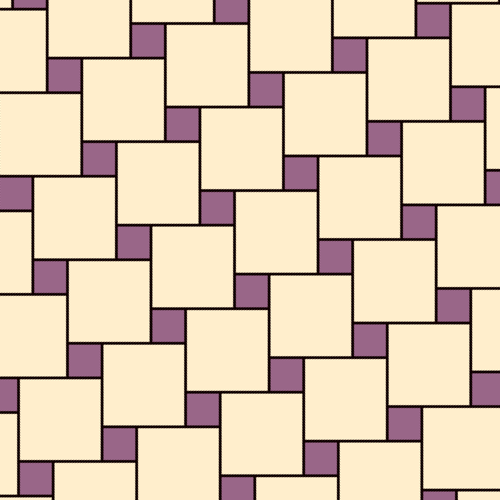
English: In order to prove the Pythagorean theorem, such a tessellation and its pattern grid can be associated to a set of puzzle pieces, as shown below.
This classical tiling is created from a given right triangle. An Euclidean plane is entirely covered with an infinity of squares, the sizes of which are the leg lengths of the given triangle: a and b. On this drawing, every square element of the tiling has a slope equal to the ratio of sizes: a / b = tan 22.5°, and a square pattern is indefinitely repeated horizontally and vertically, if we forget patternTransform="rotate(67.5)": see <pattern id="pg" in the source code. See another page for more informations. |
| Час створення | |
| Джерело | Власна робота |
| Автор | Baelde |
| Інші версії |
    On three previous images, the hypotenuses of copies of the given triangle are in dashed red. On left, a periodic square in dashed red takes another position relative to the tiling: its center is the one of a small tile. And one of the puzzle pieces is square, its size is the one of a small tile. The four other puzzle pieces can form together another tile, and they are congruent, because of a rotation of a quarter turn around the center of a large tile that transforms at the same time the tiling and the grid in dashed red into themselves. Therefore the area of a large tile equals four times the area of one of these four puzzle pieces. In case where the initial triangle is isosceles, the midpoint of any segment in dashed red is a common vertex of four tiles with equal sizes: a = b, and each puzzle piece which is a quarter of a tile is an isosceles triangle. Whatever the shape of the initial triangle, the two assemblages of the five puzzle pieces have equal areas: Periodic tilings by squares, images coded with a pattern element in SVG |
| SVG розвиток |  Це векторне зображення було створено з допомогою текстового редактора. Його вихідний код може містити додаткову інформацію або високорівневу семантику за темою. Це векторне зображення було створено з допомогою текстового редактора. Його вихідний код може містити додаткову інформацію або високорівневу семантику за темою. |




|
This image relies, or partly relies, on colours convey information. The colors used have been chosen to remain visually distinct even to viewers with colour blindness. When modifying this image, make sure that the result remains accessible to colour-blind users.
|
Ліцензування


- Ви можете вільно:
- ділитися – копіювати, поширювати і передавати твір
- модифікувати – переробляти твір
- При дотриманні таких умов:
- зазначення авторства – Ви повинні вказати авторство, надати посилання на ліцензію і вказати, чи якісь зміни було внесено до оригінального твору. Ви можете зробити це в будь-який розсудливий спосіб, але так, щоб він жодним чином не натякав на те, наче ліцензіар підтримує Вас чи Ваш спосіб використання твору.
- поширення на тих же умовах – Якщо ви змінюєте, перетворюєте або створюєте іншу похідну роботу на основі цього твору, ви можете поширювати отриманий у результаті твір тільки на умовах такої ж або сумісної ліцензії.

|
Дозволяється копіювати, розповсюджувати та/або модифікувати цей документ на умовах ліцензії GNU FDL версії 1.2 або більш пізньої, виданої Фондом вільного програмного забезпечення, без незмінних розділів, без текстів, які розміщені на першій та останній обкладинці. Копія ліцензії знаходиться у розділі GNU Free Documentation License. |
Історія файлу
Клацніть на дату/час, щоб переглянути, як тоді виглядав файл.
| Дата/час | Мініатюра | Розмір об'єкта | Користувач | Коментар | |
|---|---|---|---|---|---|
| поточний | 10:00, 26 вересня 2012 | | 750 × 750 (716 байтів) | wikimediacommons>Baelde | {{Information |Description ={{en|1=The image evokes a covering of the entire Euclidean plane with an infinity of squares of two different sizes.}} |Source ={{own}} |Author =Baelde |Date =2012-09-26 |Per... |
Використання файлу
Така сторінка використовує цей файл:
